So, let’s set the scene and get it started. So, before the Greeks were “Greeks” like we think of them, we tend to call them Mycenaean.
The Mycenaeans were a group of Aryan (meaning they spoke one of the languages in the indo-european language group) that migrated to Greece way back when.
An aside: one of the things I want to talk about in this blog is the connection between society and militarism, and how they deeply affect one another.
So, when the Mycenaeans settled, for whatever reason, they developed a highly centralized aristocracy that lived in these enormous palace complexes. Well, people call them palaces, but they are really fortresses.
Now, here is something to always, always, always keep in mind: military participation means civic/civil/social power in the ancient world. You fight in a battle and win, and if you save the country or city though your actions, that means you get a say in how things work. Also, military participation means you have a spear or something stabby and if you finally get pissed off enough, you’ll show someone why nothing beats the hobo life.
OK, so:
1) There is a very small group of people who matter, and a lot of people who don’t at all. The very small group would like this to stay the same.
2) This very small group bases their self worth largely on how well they fight other people of the same social class from different areas
So what do you do? You make it very, very expensive and hard to fight.
The main way to get around in battle in the Mycenaean world was using a chariot. Now, let’s think about this: a chariot, despite the simplicity, is still a pretty complicated machine that is going to take a lot of hours to complete. And you bet your ass the person riding in the chariot is not going to be the one building it. Plus, you’ve got to have horses to pull the chariot around.Horses are expensive, they need lots of food and water and room, and if you have a chariot horse, you can’t use it for work.
So, unless you can afford to raise and feed at least one horse (probably two) as well as pay for a chariot to be built, you’re going to be on foot while some asshole is coming after you standing on a chariot. That’s no good.
Secondly, armor (which is what I originally started this post as). So, I’m all set up in my fancy chariot, all ghost riding and whatnot before I go and try to stab another dude I might know. But what am I gonna wear?
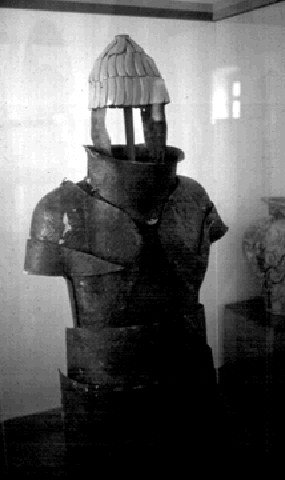
Well, you’re not going to wear last year’s clothes, and definitely not white before labor day. You need armor, and much like a chariot, its expensive as hell. Someone has to mine the metal, someone has to transport it to your hizzy, someone has to melt it down and forge it, and someone has to decorate the hell out of it. It is mucho dinero.
So, not only is it going to protect you from getting capped, but also it’s a status symbol. It says “I’m important enough to have this, important enough to fight, important enough to be listened to. Obey me!”
So, basically what I’m trying to say is that there are economic and social motivators not only in why we fight, but how we fight. I’m not saying that the poors didn’t fight in Mycenaean Greece (they might have) but the deck is stacked against them so that A) they can’t hurt one of the big boys in their armor and on their chariot (keep in mind one of these guys, all they do is train to fight, so they are pretty scary) and B) they can’t really make that much if a difference in the overall battle. It’s a process of using warfare as a way to keep the status quo, not necessarily on the receiving end, but on the participatory end as well.

No comments:
Post a Comment