Monday, April 25, 2011

The Fighting Myceaneans!

So, let’s set the scene and get it started. So, before the Greeks were “Greeks” like we think of them, we tend to call them Mycenaean.

The Mycenaeans were a group of Aryan (meaning they spoke one of the languages in the indo-european language group) that migrated to Greece way back when.

An aside: one of the things I want to talk about in this blog is the connection between society and militarism, and how they deeply affect one another.

So, when the Mycenaeans settled, for whatever reason, they developed a highly centralized aristocracy that lived in these enormous palace complexes. Well, people call them palaces, but they are really fortresses.

Now, here is something to always, always, always keep in mind: military participation means civic/civil/social power in the ancient world. You fight in a battle and win, and if you save the country or city though your actions, that means you get a say in how things work. Also, military participation means you have a spear or something stabby and if you finally get pissed off enough, you’ll show someone why nothing beats the hobo life.

OK, so:

1) There is a very small group of people who matter, and a lot of people who don’t at all. The very small group would like this to stay the same.

2) This very small group bases their self worth largely on how well they fight other people of the same social class from different areas

So what do you do? You make it very, very expensive and hard to fight.

The main way to get around in battle in the Mycenaean world was using a chariot. Now, let’s think about this: a chariot, despite the simplicity, is still a pretty complicated machine that is going to take a lot of hours to complete. And you bet your ass the person riding in the chariot is not going to be the one building it. Plus, you’ve got to have horses to pull the chariot around.Horses are expensive, they need lots of food and water and room, and if you have a chariot horse, you can’t use it for work.

So, unless you can afford to raise and feed at least one horse (probably two) as well as pay for a chariot to be built, you’re going to be on foot while some asshole is coming after you standing on a chariot. That’s no good.

Secondly, armor (which is what I originally started this post as). So, I’m all set up in my fancy chariot, all ghost riding and whatnot before I go and try to stab another dude I might know. But what am I gonna wear?
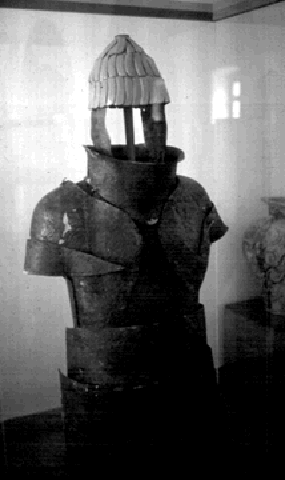

This. You're Gonna Wear This.


Well, you’re not going to wear last year’s clothes, and definitely not white before labor day. You need armor, and much like a chariot, its expensive as hell. Someone has to mine the metal, someone has to transport it to your hizzy, someone has to melt it down and forge it, and someone has to decorate the hell out of it. It is mucho dinero.

So, not only is it going to protect you from getting capped, but also it’s a status symbol. It says “I’m important enough to have this, important enough to fight, important enough to be listened to. Obey me!”

So, basically what I’m trying to say is that there are economic and social motivators not only in why we fight, but how we fight. I’m not saying that the poors didn’t fight in Mycenaean Greece (they might have) but the deck is stacked against them so that A) they can’t hurt one of the big boys in their armor and on their chariot (keep in mind one of these guys, all they do is train to fight, so they are pretty scary) and B) they can’t really make that much if a difference in the overall battle. It’s a process of using warfare as a way to keep the status quo, not necessarily on the receiving end, but on the participatory end as well.

Tuesday, February 16, 2010

S-Words


Classical Greek hoplites follow this general formula, which I have dubbed the “Kiss Ass” theory.

Keep
It
Simple
And
Stabby
Stupid

Classical Greek armies are not full of professional soldiers. They're full of farmers and craftsmen who don't have the time to learn all about how to fight. Spears go one way: in. Its petty easy to operate a spear. However, spears break, and because you can't carry a bunch of extra eight foot spears, a short sword was carried as a back up. Due to the amateur nature of the hoplite armies of classical Greece, a heavy focus was placed on using equipment with little training. Give them something complicated and they're just as likely to cut a part of themselves off as stab another person.


Swords like a rapier or a broadsword or a claymore or katana or whatever are for people who know what they are doing. People who practice with the sword and know all manner of silly things and moves with different names and plenty of room to use them in. To the Greek mentality, this was for girls. A man is born knowing how to stab, why learn something else and complicate the situation?


A side note: all this talking about Greeks inserting and “stabbing” has no relation to penises. None. No way.


Greek hoplite swords are often mistakenly referred to as “Xiphos”. This is actually not quite accurate. The Xiphos is a unique Spartan sword, shorter than normal, and usually double bladed. But for casual conversation (if you have casual conversations about swords, please consider your lifestyle choices) Xiphos works fine.


Usually 19-24 inches long with a single edge, a Greek short sword was generally short, stabbing weapon. Because there was not a lot of room in a hoplite phalanx to swing a sword or duel, basically what you want is a big ass knife. Hoplites generally carried this sword slung under the arm, where it could be easily grabbed with the right arm in the thick of combat.
Like a spear blade, these swords often had a rib in the center of the blade to keep them from breaking, but as they were often made of bronze or iron, they had a disturbing tendency to do so.


One reason why the sword was a secondary weapon – it can be assumed that not everyone carried them, was that they were expensive. The Greeks were, despite some notable exceptions, a pretty poor people. Working metal requires the energy to mine all the metal, a smith that knows what he is doing to work it so it is not crap, and quite frankly, a lot of metal. Its a pretty significant investment to make one. A spear, with significantly less metal in it, is much cheaper. A pole with a little metal on each end is much easier to make and maintain. If a spear breaks, it will most likely the wooden shaft, which is easier to replace. A sword that breaks, it takes much more to replace it.

Sunday, February 14, 2010

Let's talk about spears, baby

The spear is probably one of the oldest weapons on earth, right after the club. It's also the primary weapon of the hoplite.

So, lets start with the basics. A Greek hoplite spear was six to eight feet long, probably made from ask or yew (or really any wood available, but something with a little give was better -a little flex means less breakage.)

There's a point at each end of the spear. The main blade could be anywhere from six inches to a food long, usually a flat leaf shape with a rib in the middle. The rib is a thick part that runs most of the length of the blade, to make it stronger and less likely to break. Given the fact that spear blades were bronze or iron the metal could often break, especially in the thick of combat. A rib helped keep the spear blade intact after impact.

The other end of the spear was called the “butt spike”. You can laugh about this, I did. Sometimes, you've got to set your spear down, but you don't want it lying flat where its hard to grab, and you don't want to stick the main spear point in the ground, making it dull. So you use the smaller butt spike to drive the spear into the ground, making it easy to grab the spear at a moments notice, and to keep the blade sharp. The butt spike also can act as a secondary blade in case your primary blade breaks, or your spear snaps.

It's at this point I should mention that what I'm describing is pretty general. Military equipment in the ancient world varied greatly, especially in the non-professional armies of the classic Greeks.

Centurion

So, I realize that this should be about Greeks, but Neil Marshall's movie Dog Soldiers was great, and I'm a sucker for sword and sandals epics.

IGN Video: Centurion Movie Trailer - Trailer

Saturday, February 13, 2010

A Mission Statement

Hello,

So I guess you're reading this, so I figure as my first post I will more or less explain what I'm trying to do. Basically, I like Greek military history, from the early Mycenaean and Minoan era to Alexander and the Diadochi.

I'm going to try and cover all sorts of aspects of the Greek experience of war, because it is not enough just to say that "Greek A fought in a phalanx with Greek B and they defeated Greek C".

What was it like to fight in a phalanx, or on a trireme, or on horseback? Why did the Greeks fight this way? What does it say about them, economically, socially, and physically?

Also, understanding Greek warfare is understanding the culture as a whole. You can't really understand Aeschylus' the Persians without knowing about the Persian Invasions. The comedies of Aristopanes rely vitally on understanding the Pelopponesian War. Classical Greek theater is inextricably tied to what was happening at the time.

So, I've never done this before but I hope this experiment works.